Paradise Found?
 by Austin Williams
Britain hasn’t built a new city for half a century. Indeed, it was 60 years ago, in 1966, that the BBC visited a quaint, rural hamlet called Milton Keynes comprising a thatched pub, church, manor house and village green that was soon to be absorbed into a major New Town. Milton Keynes had been chosen because of its prime location; equidistant between London, Birmingham, Leicester, Oxford, and Cambridge. The village had existed since Saxon times, with its name featuring in the Domesday book and yet the ambition, the acceptance of urbanisation and the willingness to experiment was sufficient to carry the project through, marginalising criticism.
Careful planning over the next decade, enabled the village’s historic landmarks to remain as the area matured into a vast, green New Town with 250,000 residents, museums and galleries, shopping and restaurants, theatres and stadia, plus a thriving public business services sector. Often described as a car-centric city, the logistics and automotive sectors now dominate private employment in an economy of around £17billion, 25 percent above the national average.
One of the original residents said at the time, “We had to wait for a lot of things, but when they came they tended to be more modern and spectacular than anywhere else.”
Milton Keynes was the last city to be built in the UK. Others have tried and failed miserably. Gordon Brown’s 2007 “Eco-Towns” was a piffling project that was abandoned almost before it started. David Cameron’s “Garden Villages ” were even smaller-scale projects proposing 17 schemes of a mere 12,000 homes each. So far, Northstowe on the former RAF Oakington air base has been delayed; and Ebbsfleet’s so-called “Garden City” has built just 3,000 homes in 10 years. The list of not-so-heroic failures goes on.
Enter UK Prime Minister, Kier Starmer who has proposed 10,000 new homes each in Tempsford in Bedfordshire, Leeds South Bank, and Crews Hill in London. What they all have in common is that they are publicly-funded, make-work schemes for under-employed architects, and rallying calls for environmental protesters. The end result is lots of proposals, but very little building. The number of planning applications in the UK has fallen to an all-time low.
Britain’s contemporary record of providing sufficient urban development to cater for need, growth and the future, is risible. The original post-war new towns created under the New Towns Act 1946 were bold initiatives, culminating in Milton Keynes, but since then… nothing. Until now.
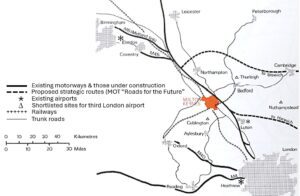
In the last 12 months, a bravura new proposal has arisen to demonstrate that not only should Britain revive its ambitions for new cities, but that it can happen reasonably quickly. “Forest City 1” (FC1) is the brainchild of journalist and businessmen Shiv Malik and Joseph Reeve, co-founder of the pressure group, Looking For Growth. The scheme is for 400,000 homes – housing a million people – situated to the east of Cambridge, between Newmarket and Haverhill in Suffolk. Almost twice the size of the original Milton Keynes city, FC1 will cover 18,000 hectares with a quarter of that set aside for a new forest. Included within its urban vision are new schools, hospitals, leisure facilities and integrated links with nearby villages. Whereas most private sector development only occurs if the project can tap into existing infrastructure (thereby cheapening the investment but depleting the available resources) FC1 hopes to construct new water supplies and waste treatment, and to improve transport connectivity with new rail links, roads and public transportation.
 How has this been received by government? The Labour government pledged to build 1.5million new homes in the next 5 years. This is a standard ambition with comically regular under-achievement. The first of those years, for instance, concluded with just 221,000 housing units granted permission (not built), which is one third down on its annual target. With this in mind, the government is apparently looking favourably on this Forest City 1 mega-project, even though it doesn’t feature in the government’s latest The New Towns Taskforce report. Here’s hoping for once, that Westminster will offer more than warm words for such an imaginative proposal.
“Britain is broken”, says the Forest City 1 website, “most especially when it comes to housing.” Here then is an opportunity to meet much of the government’s target 1.5 million new homes at a stroke… with the promise that this’ll be done within the current parliamentary terms of office (should Labour last that long).
To get this off the ground, the site – which is predominantly owned by a few landowners (reputedly a couple of wealthy members of the Lords, Sheikh Mohammed Bin Rashid al-Maktoum who is the prime minister of the UAE, and a number of solar farm companies) will be given over to a Development Corporation (named Albion City Development Corporation) similar to the one that ensured Milton Keyne’s successful inauguration. It will have the power to compulsorily purchase land cheaply. As a special economic zone, it will be given certain tax breaks and will be able to sidestep much of the bureaucratic local planning regulations, which should reveal how unnecessary most of them are. Of course, a number of vocal protestors – many of whom have not been visible in their defence of farmers’ rights of late – have discovered their love of farming in order to stop development on predominantly agricultural land.
The developers will be offering land to a Community Land Trust so that once the housing stock has been built, the homeowner will own the house but the ground on which the house sits will be protected from land market fluctuations by a legally proscribed asset lock. In this way, the developers suggest, house prices can be kept “low” with a four-bedroom family home predicted to sell for £350,000 (the current average in Cambridgeshire being upwards of £500,000). One third of properties will be rentable. Costs will be kept down, says FC1, by dealing with a pre-assembly contractor for the first real roll-out of mass-produced prefabricated housing.
But I do have some caveats. For example, curiously FC1 is voluntarily professing its environmental credentials with plans for electric trams, green cover, timber construction, solar power and “walkable neighbourhoods”. It includes biodiversity strategies, climate resilience planning and the ubiquitous carbon sequestration. These are the usual sustainability tick-boxes but Malik goes on to describe the proposed site as “industrial agricultural land” as a way of ingratiating the proposals with the environmental lobby. Greenpeace, for example, says that “The global system of industrial agriculture fuels the climate emergency and destroys biodiversity.” Using “industrial” as a curse word in relation to agriculture just to appease the likes of George Monbiot, who views farming as “the most destructive human activity ever” will ring hollow when the new city has to prepare its industrial strategy. If Albion City Development Corporation’s (ACDC) thinks that its eco-urban vision will satisfy eco-zealots, it might be in for a bumpy ride. It’s one thing dealing with green belt restrictions and environmental regulations but pretending that a new city is more “environmentally-friendly” than farmland is a foolish and precarious game.
ACDC collaborator, Paul Powlesland, who describes himself on his Twitter feed as a “climate campaigner, barrister and river guardian” says that his role is to “effectively speak for nature’s interests (given that) there is a great need to have nature’s voice represented in the planning system.” Since environmental ideology is premised on prioritising nature over humanity – indeed, where human actions are deemed intrinsically harmful to the planet – there is quite a contradiction to be resolved. Running away from it, or worse, colluding in the conceit is not the most confident start.
But for all its problems, I wish it well. It will meet scepticism, not just from fanatical environmentalists who see development as a problem per se, or NIMBYs who oppose any disruption to their area as a source of grievance – but also from those who recognise that the housing crisis has been exacerbated by the huge influx of legal and illegal immigration and the scandal of asylum seekers’ social housing allocation who may assume that housebuilding in today’s context is a zero-sum game. But regardless of population rise, it could cater for sensible population growth and the scourge of homelessness if we believed; if it could be shown; if people were convinced, that growth is a good thing. To do that, we have to tackle the mainstream, esoteric, academic, bullshit concept of degrowth or post-growth.
Thankfully, the vision for Forest City 1 is undeniably bold, ambitious and a much-needed response to the demand for “more”. In our populist times, where many people know that we cannot go on the way that we have been, proposals can be uncompromisingly audacious, because people are a little more receptive to change. The Forest City 1 proposals simply needs to convince people of the benefits of taking a risk… and that those firmly represent human-centred values.
Milton Keynes was the last of the post-war New Towns that carried the goodwill of the government, improved people’s lives, tackled poverty, offered “creative leisure” and provided open space, opportunity and uncongested, modern living to many thousands of ordinary working-class people from the inner city. The aim of the Milton Keynes developers was simply “to build a good city… that lays the foundations for organic development”. This should be enough.
____________________
Austin Williams is director, Future Cities Project and editor, “Five Critical Essays on…” series.