Mr Starmer goes to Beijing
b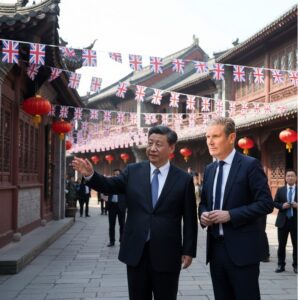 y Austin Williams
As Keir Starmer flies out to China on a charm offensive, questions are being asked about the purpose of his trip. Importantly, political commentators are asking what is to be gained, and what might be lost in these negotiations. Is this symbolic of the new alignment in the World Order, or is Starmer merely floundering between a Trumpian rock and a Chinese hard place? On the eve of his visit, a UK government spokesperson said that he would be bringing “a hard-headed, grown-up approach to our relationship with China”. What might that look like?
Successive UK governments have led the way with Net Zero policies, combatting climate change, and other environmental matters. For decades, the UK has been able to exert moral authority over China – painted as a global ecological pariah – to nudge it into amending its manufacturing practices, to look to the West for clarity, and to invest in British sustainability advisors. It has been twenty years since China’s first law on renewable energy was brought in, and now it is the world leader. By 2023, around 40% of China’s GDP growth came from clean-energy sectors. It is now able to use the West’s own moral arguments against the UK to complain that we have not done enough. But instead of giving Ed Miliband (Secretary of State for Energy Security and Net Zero) more rope to hang us all, maybe we should be a bit more confident of our real economic potential.
Britain’s trade deficit with China is around £42billion, with UK’s total exports to China amounting to £32 billion compared with Chinese imports costing £72 billion. Rectifying that imbalance would be a good start, although China will clearly be less likely to want to play ball. China’s economy is healthy by global standards, but by no means flourishing. The decline in Chinese export growth is concerning for China because it is fuelled by the over-supply of goods manufactured within the country and driven by the need for new markets. That over-supply is exacerbated by the state’s subsidy of zombie businesses creating over-production of unwanted goods, and also the stagnation in domestic consumption, which in turn is fuelled by political uncertainty, memories of lockdown, the collapse in the housing market, and a feeling in China of general ‘fatigue and malaise’.
At the moment, China is only the UK’s sixth-largest trade partner (behind US [£200bn], Germany [£62bn], Ireland [£52bn], Netherlands [£51bn] and France [£47bn]). When it comes to export markets for UK goods, China falls one further place behind Belgium. This is important to note so that we don’t let our fear of a dynamic Beijing blind us to the realities. It is also worth noting that China still only provides 0.2% of total UK inward FDI stock. With these facts in mind, Starmer might be a little more empowered to argue the case for the importance of British trade, and greater reciprocal engagement with China.
Indeed, China’s drive for self-reliance by boosting its internal consumer demand isn’t working, while looking outwards requires more meaningful global integration. With that integration comes a greater need for information-sharing and openness. It is why Starmer has an opportunity to sell UK’s creative and knowledge industries to an eager China (notwithstanding the impact of AI on both of those sectors in the near future).
China’s own creativity is hampered by a state that doesn’t appreciate autonomy and independence of its citizens. Private companies in China – especially in the tech sectors – are predominantly the vehicle through which industry is allowed to experiment before being brought back into the state-owned, state-subsidised and state-controlled orbit of the Party leadership. For those Chinese firms in Fortune Global 500 rankings, for example, 77 percent are state-owned, 6 percent shared ownership, and only 17 percent are private.
While Mark Carney and Macron are keen to jump into bed with China as a knee-jerk response to Trump’s latest threats, (Carney saying that China is a “more stable and reliable ally than Washington”), the UK should be a little more confident of its own potential. It should trade more widely with its Commonwealth allies, taking advantage of its history and Brexit opportunities – but it should also deal with China with diplomatic pragmatism. Without feeding the notion that the UK needs to sell the family silver, i.e., its world-beating advanced manufacturing, life sciences and technology sectors, it is important that Britain is also aware of its own potential. It still has quite a bit to offer, and it should not be simply hawking it around China but keeping it for itself and offering its products to the world.
Back home, the anti-China contingent in Starmer’s fractured Labour party – as well as in the rump of the Tories – are clear in their hostility to dealing with the second biggest trading block in the world and are keen to flag up the dangers from China. Of which there are many. But the same could be said about many countries. The recent acceptance of UK permission to build the mega-embassy in London is just one, but given that China has reputedly been hacking the phones of senior government officials for year, it suggests that they don’t need a secret bunker (“a colossal spy hub in the heart of our capital” as Priti Patel calls it) to carry out their espionage. Conversely, it also suggests that UK’s Intelligence and Security Committee reassurance that “taken as a whole, the national security concerns that arise can be satisfactorily mitigated” is somewhat overstated and needs improvement.
While business is business, China is also a potentially dangerous entity that we need to be wary of. This is not some special relationship amongst equals. China is an ideological powerhouse whose principles run counter to almost everything that liberal democracies ought to hold dear. The West’s studied belief that China only needed to develop economically for it eventually to embrace democracy, has been proved wrong for the last 50 years. We don’t want to give up the fight for democratic ideals as if it is a natural – or necessary – aspect of doing deals with a single-party authoritarian state. Sadly, Keir Stamer is not the most resolute defenders of democracy in its own terms, and in his own country. If Keir kow-tows in Beijing, it’ll be the start of a long period of humiliation.
.