Welsh Labour: The End of an Error
by Austin Williams
“I ddim ond dweud y gair “Ffarwél“
The closing line of Myfanwy, one of the greatest poems in the Welsh language reads “I can only say the word, ‘Farewell’”. It could easily be the eulogy to the Welsh Labour Party that has been trounced in Wales’s local elections; ending a century of domination; one that had clearly outlived its sell-by date.
The Labour Party has ruled Welsh politics from the 1920s onwards. It has won a majority of parliamentary seats in every election since that post-World War I era and has been the largest party in all of Wales’s devolved governments since the Senedd (its parliamentary talking shop) was created in 1999.
But on a day that will go down in Welsh history – even more than Llanelli beating the All Blacks in 1972 – not only did Welsh Labour get booted out on 7 May 2026, but the long-suffering Welsh public bid a fond farewell to Eluned Morgan, Wales’s First Minister – ironically the first head of government to lose her seat while still in office.
This was a devastating result. The Daily Mirror describing it as “savage”, Labour’s own Deputy First Minister, Huw Irranca-Davies admitted that it was a “catastrophic result.” Even the Guardian recognised it as an “historic defeat”. And clearly the population of the principality were not in the mood to merely wave them off without a kicking. “People have had enough,” said one. “For years we have been taken for granted if not treated with disdain”, said another. “Good riddance to bad rubbish” said a third.
Across Wales, Labour councils voted predominantly for Plaid Cymru (the Party of Wales) or Reform with a high overall turnout of 51.72 percent. Welsh Labour were irrelevant. For too long, the Labour leadership has relied on the belief that a red rosette on a donkey was good enough to win voter loyalty, and this election was intended to rubber-stamp more Labour donkeys into the Senedd chamber. It wasn’t to be.
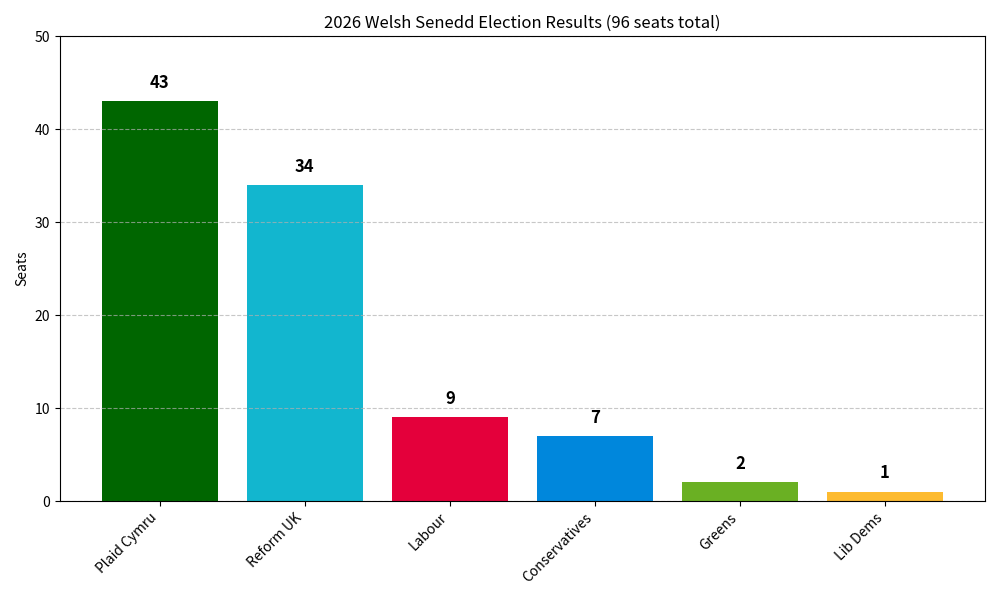
Plaid Cymru under the leadership of ex-BBC Wales’s Chief Political Correspondent, Rhun ap Iorwerth (born Rhun Jones) gained 43 seats with 36 percent of the vote, while Reform under ex-Tory councillor, Dan Thomas gained 34 seats (26 percent of the vote). Plaid Cymru will now head the Senedd with a significant mandate, and ap Iorwerth will become First Minister.
Recent gerrymandered boundary changes, new constituency arrangements, the reduction in voting age, and the introduction of proportional representation – unsurprisingly, all introduced by Labour in order to help Labour’s fortunes – did nothing to dispel the well-founded belief that Labour were a manipulative bunch of charlatans. In an expanded chamber, Labour managed to lose 35 seats and win just nine; slumping to just 11 percent of the vote.
These statistics are even worse for Labour given that the Senedd has significantly expanded in size. Labour actually shrunk from 50 per cent of the previous chamber to just 10 percent of the new one.
Originally comprising 60 Members of the Senedd (MS) representing 30 constituencies, a recent Welsh commission concluded that voters would be more efficiently represented by just 16 mash-up constituencies, each electing 6 members by a confusing process of proportional representation (PR). As a result, the Senedd now has an additional 36 MSs (taking it to a total of 96) at a reputed extra cost of £17.5 million per year. The PR system, which replicates the EU election process, relies on voters choosing parties over personalities, a technical process that was once seen as a godsend to the personality-lite, Labour-leader, Keir Starmer; but is now fairly irrelevant to his party’s chances in Wales.
The magnitude of this loss by the Labour Party cannot be overstated. Simply seeing it as a result of the voting public finding out about Labour’s election tricks and corruption ignores the fact that Welsh voters have known about Labour’s games for years but have excused them because the Westminster government was thought to be even worse. After the Brexit betrayal of Boris Johnson and the Tories, the belief that Labour would better represent Wales’s aspirations turned out to be a false hope. The reaction against years of being sidelined by English Tories and screwed by Welsh Labour has found expression in nationalist retreat or populist anger.
For the Nationalists, Plaid Cymru has long played the separatist card of Welsh identity politics, As its latest MS for Pontypridd, Heledd Fychan says, “I’ve always considered myself Welsh and European. I’ve never acknowledged my British identity.” Fychan herself is the quintessential managerial face of Plaid, having worked as Head of Policy and Public Affairs at the National Museum of Wales. Plaid Cymru’s success at this election was as much a tactical, anti-populist “Stop Reform” vote, as it was a positive vote for Welshness. And a continuation of Welsh Labour’s technocratic governance in another guise.
The populists, represented by the Reform Party, had only one sitting Member in the Senedd in 2025 (as a result of a defection from the Tories) so, their 34 seats – almost one-third of the chamber – is a remarkable victory.
But let’s be clear, this really was, first and foremost, a slap in the face the Labour Party, a party founded by Keir Hardie in Merthyr Tydfil in the Welsh valleys in 1900. The Labour movement at the time exemplified and encouraged the auto-didactic ambitions of the working class. Education was a way of fighting back against a patronising Westminster establishment. The famous story of Archie Lush, an unemployed miner who travelled to Oxford in 1927 to meet his prospective university tutor at Balliol College will suffice:
“(he) gave me a long list of books to read before I came up. When I told him I had read so-and-so, he just didn’t believe me. And he said, ‘Well, where would you get these books?’… And I said, ‘Tredegar Workmen’s Library’. Well, that convinced him, that I couldn’t possibly… But I had read them, and I was able to tell him what was in them…”
Compare and contrast. Over in the latter part of that century, and into the 21st, Welsh Labour has presided over the complete destruction of education in Wales. The dynamic idea of elevating the working class through knowledge is not even believed any more. The Labour Party would prefer to think that they are simply, and unimprovably, thick. How else can you explain that “over the last 26 years, Labour, enabled by Plaid Cymru, has delivered the lowest educational outcomes for young people anywhere in the UK.” It is no joke. A fifth of primary school leavers in Wales are functionally illiterate. (But don’t worry, Plaid Cymru have pledged that “education through the medium of Welsh” will be the solution).
As the industrial working class faded away and the trade union movement shifted towards becoming “a mouthpiece for the metropolitan liberal class”, so the Labour Party didn’t think that it needed to be representative. It revelled in the distance from its roots. The Labour Party is now a party of suits with no connection to their historic base and oblivious to the “lived experience” of what they call “working people”.
As a result, in last week’s local elections, and in Keir Hardie’s founding constituency (now redefined as Pontypridd Cynon Merthyr), Labour won just one seat to Reform’s 2, and Plaid’s 3.
In ex-Labour leader, Neil Kinnock’s constituency of Islwyn (now known as Casnewydd Islwyn), Labour won just a single MS seat compared to 2 for Plaid and Reform. In Michael Foot and Aneurin Bevan’s old stomping ground of Blaenau Gwent Caerffili Rhymni there was no Labour MS elected at all. This is seismic stuff. And it has been a long time coming.
Ordinary people lent their vote to Labour at the last general election and have endured the humiliation of being on the sharp end of Labour’s continuation of the Tories’ betrayal. In the process, Welsh Labour has shown itself to be no longer the party of the working class, but the representative of the public-sector middle class. It is the Remainer class that has long held its working class voters in contempt, often labelling them as xenophobic, ill-informed and irrelevant. The established, professional, “lanyard class” of politicians think that the public don’t remember their betrayals, but we see it every day. It’s a reason why the Tories retained just 7 seats, and the Labour Party couldn’t get to double figures.
But Plaid Cymru are no better. Plaid are just the Labour Party with leeks. Don’t ask them what a woman is (although they might translate the word for you) as they have a manifesto commitment to self-ID and are “proud of our record in having led the campaign to establish Wales’s first Transgender Clinic”. Now, however, they find themselves in the invidious position of a) running a principality that is economically on knees and; b) possibly having to do deals with Labour to get policy done (even though they say they’ll head a minority government).
The problem with the first proposition is that Plaid are now confronted with the reality of Labour’s scandalous handling of the economy: with hospital waiting times around 65 percent higher than that of the UK; educational performance below the OECD average and the lowest in UK; GDP per head around 75 percent of the national average, child poverty at 30 percent. The list goes on.
The second problem will be guilt by association. If they ally with the very party that the public just voted out, it will inevitably reveal what a bunch of charlatans Plaid Cymru really are. At the moment the olive branch offered by Anthony Slaughter, leader of the Wales Green Party (who is “’open to conversations’ with Plaid Cymru”) might be more appealing to Plaid Cymru, but of no benefit for the Welsh public whose votes will have been taken for granted. It should go without saying that the Welsh Greens preference for restricting growth, reversing Brexit, and a green jobs workforce doesn’t bode well for the people of the principality. Draught-stripping your doors with EU grants isn’t the productivity that Wales needs.
May 7th‘s results were unquestionably a political earthquake, but the ground hasn’t yet swallowed up the old parties, nor settled enough to allow the new ones to grow. In many ways, Reform have bought themselves some time by not winning this time. If they are shrewd enough, they will learn from Plaid’s mistakes and simply watch as it tries to impose unwanted campaigns on an already riled up public.
Austin Williams, director, Future Cities Project
.