Mackintosh’s Glasgow School of Art: Out of the Ashes?
 by Alan Dunlop
The Board of Glasgow School of Art (GSA) issued their long-awaited press release accompanied by architecture and technical reports on their proposals for the future of Mackintosh’s masterwork.
Regrettably, it is full of predictable and uninspiring corporate newspeak that seeks to mask the absence of a viable plan and fails to address multiple important issues. What grates most perhaps, is their statement that the Mackintosh can “have a new purpose and become a catalyst for innovation, regeneration and economic growth for Glasgow.” This obscurantist utopian waffle is nothing less than the public abdication of their much-defended responsibility to deliver on their promise of faithfully reinstating Mackintosh’s masterpiece, that pays homage to its previous purpose and stature.
The images that support the Architectural and Technical report, fundamental to communicate design intent and to define how a reinstated 1909 building will meet contemporary structural, fire safety, access, and sustainability requirements are soulless. This is indicative of a lack of ambition- for there is arguably an opportunity here to create inspirational civic space of potential international merit, respecting the devastated ruins of the Mackintosh and the purpose that was in its DNA. Mackintosh’s School of Art was designed as a catalyst for life drawing, painting and sculpture, a unique and beautiful building, with large north facing studio windows, deemed sadly, to be no longer necessary. This view is driven by the school having shifted its emphasis away from drawing and painting to “environmental art”, digital art, 3D designs, graphics, and the electronic games designs that so captivate Turner Prize judges. It is an approach that is both craven and reductionist.
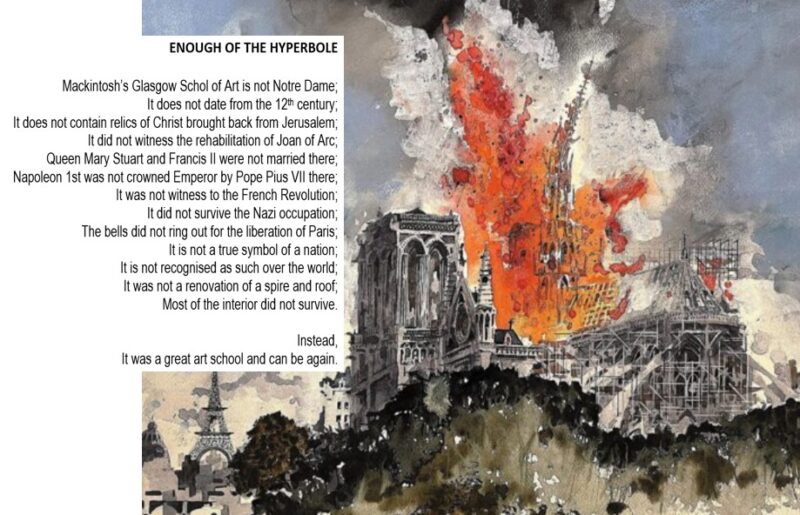 However, none of this should be a surprise to anyone. Much public comment since the second fire has centred on the frailties of the GSA board who have exhibited poor communication, a disregard for transparency, and an apparent lack of strategic focus. Their intention now is to embark on a £265m “enabling” project for a new building, seeking development “partners” and public money.
“We’re aware that there are differing ideas and people who obviously hold the Mackintosh very dear in their hearts, but this is not going to be an exact historical return. ……. we can’t go back to that idea of what people are holding in their memories…,” declared Ann Priest, Chair of the GSA.
This is perhaps a more realistic and pragmatic approach but bereft of an obvious plan and still secretive about the actual sums of money involved (detail on the quantum of financial settlement from the insurers having not been released) it leaves many questions unanswered.
 The GSA’s commitment to a “faithful reinstatement,” has been demonstrated to be a folly- a major error of leadership and judgement – a dangerous and expensive pipe dream that militated against open discussion and debate on alternatives, but one that they have clung to publicly for years. It looks like that fantasy has been crushed on contact with the reality of modern building requirements, costs, and their own capacity to deliver. Mackintosh, the genius, would surely have argued for innovation and ambition- for creative contemporary solutions- not replication and prescription of historical forms. There is no doubt that the remedy to this situation requires an exceptional architectural team garnered through a proper procurement process that emphasises talent and creativity in what is the most important commission in Scotland and probably the UK.
Where to next? Well, who knows? Perhaps the Board will acknowledge the many challenges involved and their capacity and respond to calls for the setting up of a specific vehicle Trust to focus solely on the delivery of the new Mackintosh, allowing them to better manage their other duties.
_____________
Professor Alan Dunlop is an award-winning architect with a portfolio of built projects. Since graduating from the Mackintosh School of Architecture Glasgow School of Art he has mentored hundreds of students and lectured worldwide. He has written extensively on architecture and urban design. Two books on his work, Challenging Contextualism and Curious Rationalism, have been published. His architecturally related drawings and paintings have been exhibited internationally.