What’s so good about council houses?
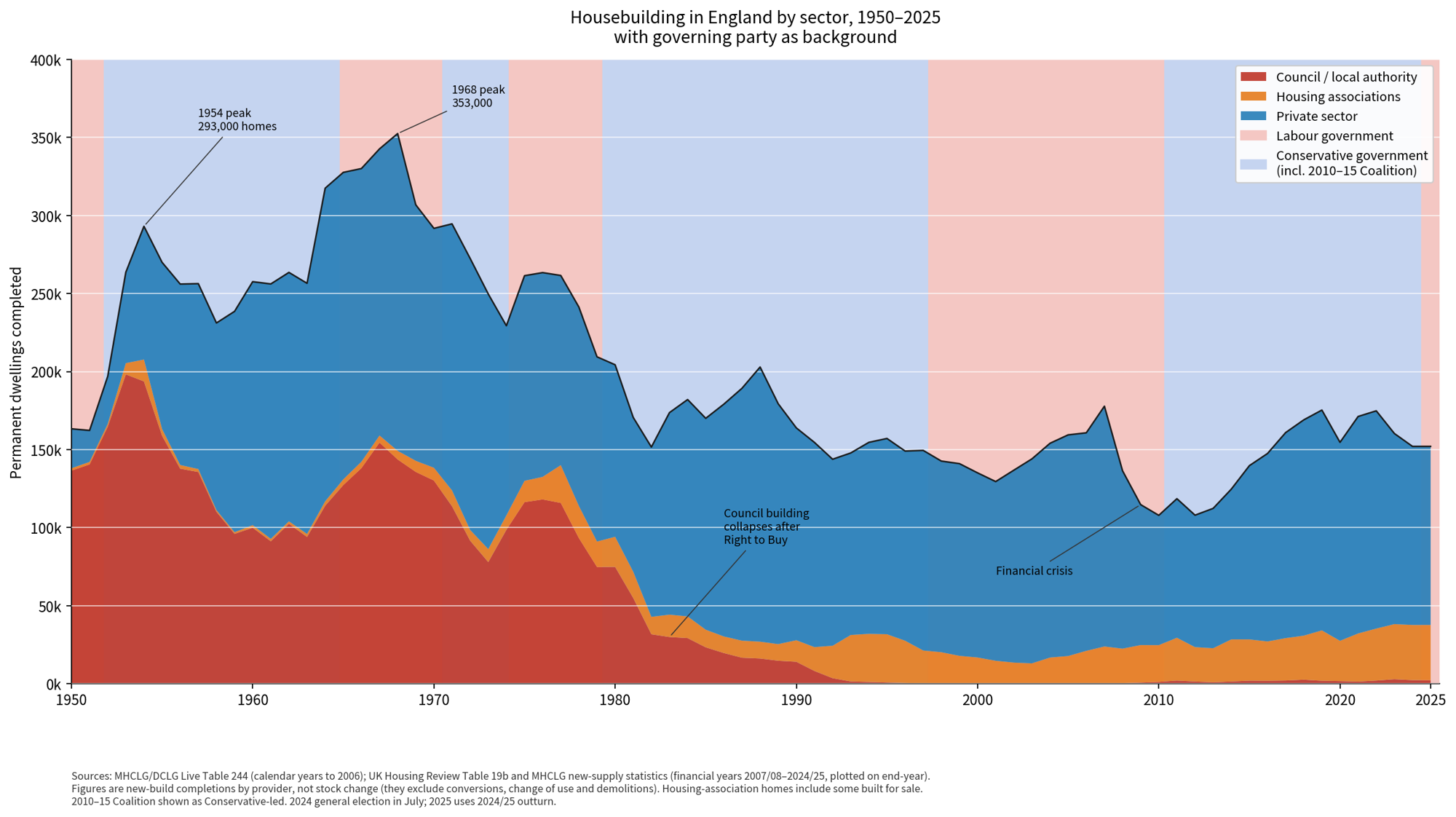
From a post-war high, the terminal decline in council house-building began after Margaret Thatcher introduced the Right to Buy scheme in 1980. In 1953, 200,000 council homes were built in England, falling to 75,000 by the time Thatcher resigned. By 1990, that figure was just 87. The less well-known story is that council homes continued to flatline under Blair so that after ten years of the Labour government, a mere 2,000 council properties had been built in England.
 Today, social housing is fashionable again. Andy Burnham has put a new generation of council homes at the centre of his politics. For much of the left, this is an overdue fight against neo-liberalism and private ownership, and a state-sponsored “housing first” answer to homelessness. As the Local Government Association says, “council housing has been essential in helping the most vulnerable in society gain access to a home”. Surely, with around 1.3 million households on the waiting lists in England alone, they have a point. Something must be done.
Admittedly, most of the meagre supply of social lettings go to UK nationals, but for a population impacted by migration, vulnerable and desperate locals see queues lengthen and conclude that allocation is a lottery run for newcomers. Around 31% of London’s social housing occupants, for example, are foreign nationals not holding a British passport. Is that a problem, or a civic duty?
To increase provision, can we rely on councils come to the rescue? Stripped of their stock, skills and much of their funding, many can barely manage existing estates, let alone run a construction programme. Reports state that Croydon, for example, set up a development arm called Brick by Brick, lent it about £200 million and now has to write off £65 million for a grand total of three council houses. Similarly, Liverpool Foundation Homes allegedly built 18 properties (none at social rent) and left the local authority with a bill of £3 million. Building houses is not easy, and it is certainly not easy money… as the private sector will attest. The average private housebuilder ends up with a profit margin of 8%, and currently there are around 1500 private housebuilder insolvencies every year.
From their heyday in the 1990s, housing associations still build around 25% of today’s total housing supply (council housebuilding is a mere 2%), but their “affordable” rents are not social rent. Burnham’s own Greater Manchester shows that genuinely cheap homes lag luxury towers and waiting lists for the less affluent are barely impacted. Shelter reveals that Manchester has one of the highest per-capita rates of homelessness outside London. Devolution, it seems, can bring decisions closer to people but it can also expose how thin local capacity really is. A council-house renaissance needs bricklayers, electricians, plumbers, site managers and a training system that has been neglected for years. Construction already reports some of the worst skills-shortage vacancies in the economy.
This article started off by asking: what’s so good about council housing anyway? But if that is a given, should allocation prioritise local people, or the most vulnerable regardless of origin? Should the government cancel the Right to Buy to maintain existing stock in public ownership? A final question to end with: is Angela Rayner’s pledge to spend £39 billion on a 10-year Social and Affordable Homes Programme throwing good money after bad?
–