Chinese Cinema: the Highs and Lows
Once Upon a Time in the Middle East (Chinese title: Welcome to the Dragon Restaurant]
dir: Wen Muye (2026)
China’s cinema has greatly improved in the last few years. Not only are Western film-makers chasing the Chinese yuan; from ‘Crazy Rich Asians’ to featuring Chinese leading men in Marvel’s ‘Shang-Chi’, but the output from Chinese studios has improved massively. Over the last decade, China has put in the money, nurtured the technical skills, improved its creative talent, and is now becoming increasingly influential in world cinema.
Most films still contain a propagandistic edge, as all films shown in public theatres in China must be officially licensed, censored, and approved by the state through the China Film Administration, but it’s more nuanced than before. The 2015 and 2017 Wolf Warrior series promoted Chinese expansionist military prowess in a sub-Rambo-esque franchise. In Wen Muye’s latest offering, ‘Once Upon a Time in the Middle East’, PLA jingoism is downplayed and subtle national pride in Chinese culture is placed centre stage. In this film, the Chinese are simple, innocent peacemakers.
The film’s title for Western release seems clearly to be a play on the Sergio Leone classic cowboy movie, ‘Once Uon a Time in the West’, which veteran film reviewer, Keith Phipps says is a “film about what’s gained and what’s lost when civilization reaches the frontier.” The Chinese film – admittedly using a completely different storyline – mirrors the claims of a civilising mission: the frontier development by China in the Middle East, and the exhaustion of the Old West. Here Chinese characters are clearly representative of the prospects for stability.
The plot, inspired by real events, has a complicated range of twists and turns that keep the audience guessing. As a 150-minute saga, it is reminiscent of the 1970s hey-day of US long-form cinema, from ‘Papillon’ to ‘Cool Hand Luke’ which were thrilling in their storyline complexity. Epic movies of blood, sweat and tears where the protagonists, trapped by the system, rely on luck, resilience and endurance in order to escape. This movie has a similar thread, with the central protagonist – emblematic of China’s foreign policy in the Middle East – surviving in a hostile world.
Chef, Xu Fu leaves his family to travel to the fictional Middle Eastern city of Bahata (clearly referencing Baghdad and the 2003 Iraq war) to work at a struggling Chinese restaurant simply to make enough to pay off his debts. With the help of the restaurant’s manager, he transforms the place into a thriving business through authentic Chinese cooking, and the camera lingers long on the preparation of his colourful dishes, tapping into Chinese audience’s love of food and the popularity of series like ‘The Bear’ in the West.
When war with America erupts, the restaurant becomes a refuge for local orphans and civilians, forcing Xu Fu to risk everything to protect his newfound community amid the chaos and devastation. As the story unfolds, America are revealed as fools and cowards, Islamists are barbarians, and the Chinese are the ones with fortitude; holding on to normality.
With a cast of characters from three continents, many of the Chinese actors are fluent in Arabic. This serves to emphasise China’s assimilation in the Middle East and its moral supremacy against the heavy-drinking, linguistically-challenged Americans. This film is a marked shift in Chinese cinema with fine performances that range from the comedic to truly heartbreaking. Messaging aside, this is definitely worth a watch.
Now for the bad news…

Nui Lai
dir. Xin Yumeng with Sun Lifang (2026)
Titled “The Cow is Coming” this 86-minute budget animation movie was 5-years in the making and was created by a mother and son team of amateurs. The reviews suggest that they had no computer nor animation training, but that is obvious from the very start. This is the slowest, dullest, worst animation ever created. It is the story of a calf growing up learning about the simple things in life. Unfathomably, it has grossed $10 million domestically.
One review hints at the appalling graphics as a “welcome tonic in the age of artificial intelligence” and, in some way, it has been applauded for its hand-made authenticity. It goes some way to prove that we appreciate effort more than we admire AI-created polish. But this is stretching a point.
The story, such that it is, centres on a calf named Niu Lai, who finds it difficult to stand. Within minutes, and for the duration of the film, all animals walk on they hind legs and jump like Ninjas. Bitten by a snake, Niu Lai learns to be wary of others, but also the importance of bravery. His mother imparts fortune-cookie-style words of wisdom, such as “Today is the future of yesterday”. It is hardly Confucian in its profundity.
Apropos of nothing, Niu Lai befriends an orphaned leopard who later comes to the rescue of the herd by fighting off a pack of wolves. That’s it. That’s the story… other than the desperate storyteller’s device that, by the end of the movie, we realise that it was all a dream. Or maybe a nightmare.
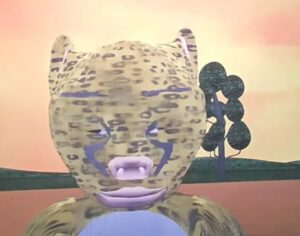 It goes without saying that none of these animated characters look remotely like the animal that they are representing. The quality of the animation, the skill of the artist, the coherence of the scriptwriting team, the charm of the voice artists, are all entirely absent. I will concede that some of the storyboarding and shot composition are often well done but I don’t want to lead you to believe that the film is any good. After all, it cost just $500 dollars to make.
What seems to be the appeal to Chinese audiences is that it represents a simpler world, reminiscent of cheap children’s cartoons. There is something of a rejection of slickness, polish, and complexity in audience responses, where young people are expressing their longing for a shelter from the changing nature of their world.
The state has instructed people not to go to see this film. The movie industry in China wants to build up credible cinematic soft power on the world’s stage and clearly this awful animation risks making Chinese film industry a laughing stock, and the state worries that by association, it too might become compromised. But audiences have kept coming – laughing at the absurdity of the situation. I have watched it so that you don’t have to.
by Austin Williams
***********